Saturday, November 2, 2019

Promote Your Blog Posts with Ethical SEO Guide

A blog is a traffic magnet. Social media traffic, referral traffic and, yes, organic traffic.

On average, marketers and content writers spend more than three hours on a single blog post.

Organic traffic is also the source of most of our customers.

All this happens because we took the time to optimize our blog posts.

If you don’t want to miss out on organic traffic and potential customers coming through this channel, read on.

Optimize your blog posts for SERPs in a few simple steps:

1. Find the right keywords

Great SEO isn’t just a matter of ranking. It’s a matter of ranking for the right (read: profitable for your business) keywords.
How do you find these keywords, though?
Always focus on these three rules of thumb
  • They’re long-tail keywords
  • They match user intent
  • They match your business goals
Here’s why you need all three. Long-tail keywords aren’t just easier to rank for. They are also easier to match with user intent (as they are more specific) and with business goals. 

My process is this simple: if a keyword doesn’t pass all three questions it’s booted. We move on. 

2. Use those keywords

Now that you’ve found the perfect keywords, let’s put them to good use. 
Very important: good use doesn’t mean stuffing your content with them. This won’t get you ranking but it will get you penalized. 
Here’s an example of what keyword stuffing looks like:
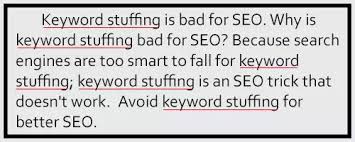
Image via Quora
How often is too often? Well, the ‘law’ is unclear on that.
The rule I follow is keeping the keyword density below 3% and ideally below 2%.
However, you don’t have to abuse those keywords in order to rank for them. You just have to stick them in the right places:
  • Title
  • URL
  • First paragraph (or first 100 words)
  • Last paragraph (or last 100 words)
  • At least one subtitle
  • Alt image tags
  • Meta description
  • Sprinkled reasonably throughout your content
Rule of thumb here: just write naturally. Don’t force it. If your human readers like it, so will Google bots.
Additionally:
  • Use plenty of synonyms to your main keyword(s)
  • Use LSI keywords – a quick guide here

3. Optimize every asset

Don’t just optimize your written content or text body. Use your keyword (and its variations) in:
  • Image tags
  • Meta description
  • Video tags
  • Social media captions

4. Promote your optimized content

Submitting it to Google isn’t enough. We already know the biggest Catch-22 of organic traffic: the most popular websites/posts, get ranked higher and, thus, get even more organic traffic.
One other thing that’s relevant to your ranking is the number of traffic sources. So help your content become the most popular kid on the block. Here’s how:
  • Share it on social media. Not just once. Organic reach isn’t your friend, so make sure you share it multiple times at different times of day to reach a bigger chunk of your audience.
  • Tag media outlets/influencers you mentioned. Did you link to anyone’s website in your post (you should! See below)? Email them or tag them on social media. They are likely to share your post.
  • Turn it into an ad. Even a smidge of a budget on Facebook ads can boost your posts popularity immensely. Try it out.
  • Email it to your list

5. Use best linking practices

There are two major categories of links that help your blog posts grow (except for the backlinks you earn, of course)
  • Outbound links – links to other (preferably high-authority) websites. This proves that you’ve done your research and checked out trustworthy sources to back up your claims.
  • Inbound links – links to other blog posts or web pages of yours. This helps Google better understand your content. It also helps your pages/posts rank higher. An inbound link from one of your top-performing posts to other posts helps the latter gain more traction in SERPs.

6. Be useful

I’ve said this countless times: don’t write for search engines. You’re not in business with them. Write for humans, for their pain points and needs. They are the ones you want to be in business with.
Make sure your content is neatly organized, easy to read (bullet points and headlines help a lot!) and, above all, useful.

If humans, find your content useful, they will read it, share it and come back to your blog for more. This is earned traffic aka the best kind of traffic. The kind that Google rewards with better rankings.

Wrapping things up

The most important thing about blog SEO is to never forget about its purpose. No, that’s not traffic. Traffic doesn’t pay the bills.
It’s getting customers.

Write for them. Choose keywords that match their needs and pains and write in a way that is compelling and truly helpful to them. Not to you, not to search engines.

Not sure how to achieve all that? We are! Take a look at our copy writing and content writing services. We create content that BOTH human readers and Google love. And we’d be happy to create some for your business, too.

Tuesday, February 19, 2019

SEO Steps to Promote your Blog for Better ROI

So many bloggers out there who struggle to get quality, targeted traffic to their websites from blogs. However, this is not uncommon because most people do not know how to implement proper SEO strategies to get noticed in the major search engines and get better Return on Investment (ROI). 

In this article, we are discussing major SEO tactics to use for getting the most exposure out of your blog. Organic traffic generated from the search results is not only free but can be some of the best converting traffic around.

Here are the essential tips to give emphasis as follows:

1. Optimize Existing Meta Tags 

Your meta tags are truly the foundation of your website when it comes to SEO. This is one of the first areas that Google will look at when trying to determine what a given page is about. It is critical that you optimize your meta tags to the best of your ability with target keywords in place (and without keyword stuffing). You may even benefit from doing a simple SEO audit of your website using a tool like Screaming Frog to scrape out your current meta tag data.

The meta tags that we will discuss today are Title Tags, Meta Descriptions, Header Tags and Image ALT Tags.
  • Title Tags: Your Title Tags hold the most weight in the eyes of Google and should contain your most important keyword phrases. These are seen in the search results as the blue clickable hyperlink when you perform a certain search query. It’s a best practice to try and keep these as close to 70 characters in length without going over.
  • Meta Descriptions: Meta Descriptions show up underneath the Title Tags in the search results and are the short snippet of text that describes what that ranking page is about. Every page or blog post on your website should contain a unique Meta Description that is compelling and encourages people to click-through. Try to make these as close to 160 characters in length as possible without going over. 
  • Header Tags: Headers (H1, H2, H2, H4 etc.) are the only meta tags that actually show up directly on the website. These are generally the main heading that is above an area of text on a webpage. Header tags also hold a lot of SEO weight and should be optimized with your most important keyword phrases in place.
  • Image ALT Tags: When you upload an image to your website, you are able to apply a keyword rich Image ALT Tag to it. This allows for additional optimization and should be added to every image on your website. 

2. Generate Consistent Content 

Content is truly king when it comes to SEO. Writing optimized content on a consistent basis, while ensuring your meta tags are optimized properly (as discussed above), is a powerful tactic for generating floods of organic traffic. However, you want to ensure that you’re always providing immense value in the content you produce. Do not just throw anything up on your website as most people will be able to see right through it.

Let’s talk about consistency and optimization for a minute here. Your content creation schedule needs to be consistent and remain that way for the long-term. At the very least, you should be publishing one high-quality blog post per week in order to start gaining some traction. With each article you write, try to sprinkle in some of your target terms within the content and also add a few internal links to other relevant pages on your website. The internal links will help users navigate your site more efficiently and also spread some link juice from page to page. Over time with enough optimized content on your website, there’s a good chance Google will start ranking some of these articles and that’s when you can really start to see some momentum.  

3. Building Quality & Natural Links 

Now in order to bring everything together, you must build quality back links to your website. This will help drive higher search engine rankings which in return will generate more organic traffic for your website.

One specific strategy that is both effective and powerful is guest posting. This is where you would simply reach out to other relevant websites in your niche and see if they are accepting article submissions. You would generally want to pitch them 3-4 blog topic ideas for them to choose from. Once you receive the green light to start writing your article, you would simply add your website URL within the body or author bio. When this article is published, you will build yourself a natural and quality backlink!

You will want to try and guest post on websites that have a solid domain authority for the best results. You will also want to target different pages in your guest posts to diversify your link building efforts. Meaning, don’t just build links directly to your home page. Mix it up a bit.

Like generating consistent content, link building should also be an on-going effort for the growth and health of your blog. Over time, this is really how to produce noticeable ranking movement in the search engines. 

In conclusion, please keep in mind that SEO is a long-term strategy and should be approached with the right mindset. It takes time to produce quality content, optimize your tags properly and build quality back links. If you are diligent and persistent with your efforts, it’s only a matter of time until you start gaining more exposure for your website.

Tuesday, April 24, 2018

Get Top SE Rankings with Latest Social Media Practices

Social media marketing and search engine optimization are strategies used by businesses to create a unique identity of their businesses to attract more customers to their websites. These two strategies are highly related since an organization’s availability on social media platforms such as Facebook boosts its search engine rankings.

Business owners often fail to understand the relationship between social media and search engine optimization and how the two can significantly influence Google rankings.

Understanding the relationship between these two aspects and monitoring possible social media practices is crucial for the growth and popularity of your business. Several social media practices can be implemented by your SEO team to improve Google rankings. Here are some latest social media practices that can boost your search engine optimization.

1. Increase the Number of Your Social Media Followers

The Number of followers that any social media profile has greatly influences search engine ratings. Followers of a given website can influence can influence its search engine ranking through search engine optimization boosting. For example, a company with many Facebook likes and twitter followers get a boost in Google ranking compared to its competitors with fewer followers.

It’s essential for a company to attract and build its followers in a more organized and acceptable manner since Google detects any mischievous practices such as paying for twitter followers and Facebook likes. Practices such as opening discussion forums, writing and posting articles are powerful ways of increasing followers on social media platforms.

2. Encourage Social Media Sharing

Enhanced sharing on social media is among the top ways of increasing product awareness and improving your search engine optimization efforts. Make use of external links to access market segments through continuous social media sharing. When you invest heavily in social sharing, there will be increased popularity of your products and brands among customers which influences SEO.

To benefit from social sharing, you need to ensure your posts are creative and attractive. Potential customers are willing to share great your great content across different social media platforms. Increased sharing of your content boosts the number of posts that have your links which boosts your search engine optimization ranking.

3. Optimize Social Media for Searches

This strategy helps in opening up channels to direct your profile viewers to your various posts. These posts can be videos, articles, or even newsletters. Posts are meant to provide opportunities where the company becomes popular on social media and increases the chances of your website ranking better.

Optimization of content on social media platforms will always have a positive impact on your SEO efforts. Focus on providing quality information in your industry through your social media posts. Optimization of social media posts helps in making your website more visible hence pushing forward your search engine optimization strategies.

4. Enhance Your Brand Awareness

The popularity of your site and brand positively correlates with the results of your search engine optimization campaign. Increased brand and site awareness increases the traffic to your website. Social media, therefore, can be used to boost the reputation of your business. Attracting and retaining customers together with increasing the number of searches is greatly influenced by the ability and strength of social media utilization.

As a marketer, you can take advantage of social media platforms to inform your audience on the latest unbeatable discounts, promotions, and new products that you are offering. This will help you to attract more social media users to enhance brand popularity. You will end up attracting more potential clients which increases the number of visitors who come to your site.

5. Optimize Posts Locally

Optimizing and promoting social media posts within your local community provides significant benefits to your SEO campaign. It’s worthy to adapt local search engine optimization since local clients facilitates your business promotion posting information related to your company. You can also engage the local community through various events to boost the popularity of your business brands. Any content on social media from the local community boosts the search engine optimization process.

6. Encourage External Inbound Links      

Social media platforms offer you a great opportunity to link your content to external sources. The external links you have, the higher the Google ranking you get. To attract more visitors, you will have to publish high quality and authoritative content to attract authoritative external links as well. Also, remember to use social media channel to spread your useful and original content which serves as a bait to social media users. Doing so not only increases your chances of attracting authoritative external link but also boosts your social media reputation.

Friday, April 13, 2018

Get Better On-Page SEO Impact on Your Business Websites

With so many businesses being launched everyday, how can you ensure that yours stands out? If your business has a good, first page ranking in search engine results, what can you do to stay on top?
  
Studies show that on desktops, the top-ranking page in Google search results has a conversion rate of almost 35%. And on mobile devices, its conversion rate is almost 32%. This shows how important it is to improve your search engine ranking and boost your site’s visibility.

SEO helps you optimize your website so that more users are able to find you on the internet. 61% of marketers say that SEO is a top priority when it comes to inbound marketing. This means that the competition is getting tougher. You need to build your brand’s presence online by taking steps to improve search engine rankings. 

Optimization of keywords, meta tags, title tags, and URLs are some of the common ways to improve a website’s SEO. But with changes and updates in how search engines rank a website, you need more than that. That is where on-page and off-page SEO come in. And this post is going to focus on on-page SEO.

On-page SEO involves optimizing a web page through internal organization, while off-page SEO refers to external configurations. 

Here are some of the best ways you can improve your on-page SEO:

1. Maintaining Website Speed

47% of customers believe that it shouldn’t take longer than 2 seconds for a web page to load. And even a second of delay can reduce your pageviews by 11%, and your conversions by 7%. A fast loading website is the key to an engaged audience. On the other hand, a slow-loading page makes people impatient, which leads to a higher bounce rate. 

For Google, a website that loads faster gets a higher ranking in search engines. Google’s PageSpeed Insights helps you determine the total time taken for your website to load. Once you know what’s slowing you down, you can take the necessary steps to improve your website speed.

2. Using AMP

Mobiles account for over 50% of website traffic, and this number is only going to increase in the coming years. For this, it is important that websites load almost as fast on mobiles as they do on desktops. This is what led to the creation of Accelerated Mobile Pages or AMP.

AMP is nothing but a coding standard that helps websites load instantly on mobile phones. When you do a simple Google search, all the top-ranking results have an AMP tag, especially when it comes to news stories. You’ll be able to see a little lightning bolt symbol on top. 

Although it is not owned by Google, it has the company’s support. This basically means that when it comes to indexing websites, Google’s search engine algorithm will consider AMP. With AMP, websites have seen a 20% increase in sales conversions.

3. Responsive Site

A responsive site means that the site has been designed to cater to the design needs of different devices. In 2015, Google announced that mobile-friendliness of a website will be an important criteria in search engine rankings.

Mobile search optimization is important for strong on-page SEO since there are more people using smartphones. At least 90% of people in the U.S. use a smartphone. People use smartphones for searches to buy things, to read, and to access social media. 

Desktop websites are heavy and cannot load as well on mobiles and tablets. To improve user experience, businesses need a responsive design so that desktop, mobile, and tablet users all have the same experience. The idea is to ensure that the website understands which device is in use, and then adapts to it.

4. Creating Engaging Content

Nothing beats good content when it comes to search engine rankings. Original and relevant content gets a better search ranking. 

For Google to crawl a website, the content needs to be at least 500 words. In fact, the average length of articles on the first page of Google ranking is 1,890 words. Long-form content of over 1,000 words tends to get more likes and shares. This means more visibility in search engines.

Make sure that the content is written in a simple and concise way. People should be able to understand what you’re saying so they can stay engaged, otherwise they will simply bounce away. 

Using Long-tail Keywords for Optimizing Content

Keyword optimization is important when it comes to SEO but with long-tail keywords, your website will get more diverse and relevant traffic. There will be plenty of websites which may be using same or similar generic keywords but if you want to target your niche, you need to stand out.

A long-tail keyword may not be used very often in search engines but they lead to a target relevant audience. Long-tail keywords are valuable and more specific to a customer’s needs.

Run a competitors search and figure out all good keywords that your competitor is targeting then start from there to get some traction. There could be 100’s of long tail keywords to monitor for which your website might be ranking but that are unknown to you. A ranking tracking tool like ProRankTracker can be a great help in this area.

5. Use of Internal Links

Internal links connect a web page with another page on the same website. If your web page contains 2-3 internal links, then it helps the search engine determine the relationship between the pages. A search engine crawler then gets an idea what your website is all about and then ranks your site accordingly.

That’s why internal links are important for good on-page SEO. They help a user navigate your website smoothly. And even for a search engine crawler, if there are no internal links, those web pages are left out of indexing and they simply don’t exist. A good website should have links to other relevant internal pages spread out evenly throughout the website.

6. Use of HTTPs

In 2014, Google made HTTPS encryption for URLs a ranking signal. HTTPS or Hyper Text Transfer Protocol Secure is basically a website security certificate known as the SSL or Secure Socket Layer certificate.

This makes any kind of data breach difficult by making any external sharing of data almost impossible. HTTPS makes a website trusted by Google. It is very important for ecommerce and banking websites especially when more people are making online transactions.

It is believed that HTTPS enabled sites get a very minor boost in search engine rankings, but it is still important for on-page SEO, especially since Chrome puts a “not secure” mark on non-HTTPS sites. Seeing this mark could alarm many of your visitors, who could end up leaving soon after landing on your site. This will increase your bounce rate, affecting your search ranking. 

7. Use of Structured Data

Structured data is nothing but organized data. In SEO, structured data means a markup on the web page that provides more details about its content. It helps search engines to go through your website and understand what it is about.

Here’s how it will look in search results pages. People will be able to see details such as the star rating, number of reviews, price, stock status, etc.

Search engines like Google have a markup tool that can help you with structured data for your website for improving on-page SEO. Structured data means enhanced search results with more images, videos, GIFs and other styling elements. This increases click-through rates and drives traffic.

Conclusion 

Google, the undisputed market leader in search engines, has made a lot of changes in its search algorithm in the last few years. With these new factors for website ranking such as good loading speed, AMP, HTTPS, internal links, structured data, and engaging content, SEO has become all the more technical. 

Boosting on-page SEO through these techniques is time-consuming, and can be a problem for someone who doesn’t understand these technicalities. If you know more ways to improve on-page SEO, let us know in the comments below.


Tuesday, February 20, 2018

Tips to Improve E-commerce Sales with Product Recommendations

Businesses know that acquiring new customers is more difficult and costlier than selling new products to existing customers. This is why eCommerce businesses prefer to invest in a good loyalty program. And product recommendations is one of the best marketing tools that a retailer can have in its arsenal. After all, the right recommendation helps sell more products to existing customers.

Simply put, recommendations are suggestions made by the retailer on various things that the customer might also be interested in. But in order to do this, the company has to know its customers and what they want. This is to avoid scenarios like recommending red stilettos to a client who prefers white trainers.

The question now is how to successfully use recommendations to improve eCommerce sales. Here are five suggestions:

1. Generate Personalized Product Recommendations

Personalized recommendations are carefully calculated and chosen products that are offered with the customer's shopping behavior and history taken into consideration.

Amazon is a prime example of personalized recommendations. First-time site visitors will initially see some generic suggestions that are either crowd sourced bestsellers or what other visitors are checking. But once a purchase has been made, they'll see recommendations based on items they've bought or searched for recently. These suggestions are found in the product description of the item a customer is currently checking or on the homepage that they're logged into.

Improve E-commerce Sales - DillipKumarBarik.blogspot.in

2. Have Well-Timed Customized Email Recommendations

Email marketing is still one of the most effective marketing strategies. It's affordable, practical, and can boost conversions. But to have a more robust customer engagement, personalized email recommendations are the way forward. After all, the more relevant the email's content is, the higher the rate of emails opened, website visits and sales.

Amazon is again a good example of this strategy. The company's AI sends well-timed emails that recommend products that the customer has just browsed on the site. The emails are also sent as soon as the customer leaves the site, thereby ensuring that they're still receptive to recommendations.

3. Make Product Pages More Appealing With Relevant Suggestions

The product page is one area where you can make more recommendations. However, it's important that you find the best way to showcase your items because at this stage, you'll either push your client towards the checkout process or drive them away altogether. Data-backed recommendations can provide shoppers with more choices at this key stage. By putting together selections based on the customer's interest, the odds of conversions can increase by as much as 411%.

Brands can boost conversions by suggesting complementary items. For instance, if the shopper is looking for shoes, they can cross-sell by suggesting a shoe rack. Product recommendations can also be based on the shopping patterns of other shoppers. For example, if previous shoppers also bought a necklace after buying a blouse, then the product page would recommend what “people who bought this product also bought.”

4. Don't Stop at a Confirmed Order

A successful order confirmation doesn't mean you have to stop making recommendations. This stage of the shopping process can still be a good arena for recommending items that the customer could buy. Think of it as a last chance to add more products to the deal.

There are two good ways to make the most of order confirmations. One would be to have recommendation popups. Aside from thanking your customers for their latest purchase, include messages that suggest “you might be interested in this product.” The second way would be to integrate recommended products in the order confirmation email. Make your offer more compelling with the promise of freebies or discounts in their next purchase.

5. Making Friendly Referrals

As already mentioned, recommendations shouldn't stop just because a purchase has been made. Recommendations can be used as a referral tool, one that can push a brand further, generate traffic, and boost more sales.

Brands can do this by asking customers to share the news of their latest purchase with their friends via social media. Bear in mind that people are more likely to buy or use the same brand that a trusted friend has used and recommended. To make this easier for your customer, integrate a “Share This” button on the customer's order confirmation page.

There's no question that recommendations have positive results. It's a marketing strategy that eCommerce businesses can easily adopt. So this year, put more emphasis on recommendations and see your sales numbers grow.

Monday, January 8, 2018

Happy New Year - 2018

Wishing all a Prosperous, Peaceful, Good Health and Happy New Year 2018 !!

Happy New Year 2018 - DillipKumarBarik.blogspot.in

Saturday, September 2, 2017

Do SEO to Generate Business Leads from your Website

A website parked on the internet, without SEO and some-one constantly tweaking the SEO, will never be found in online searches and will never generate an organic business lead.

Organic leads that convert into sales, are certainly more cost effective for your business than leads obtained through PPC (Pay per Click) marketing. The key purpose of SEO is to attract organic leads to your website, rather than the websites of your competition.

The best way to ensure organic leads come to your business, rather than going to one of your competitors, is to rank higher than them in search engine query results, for your chosen keywords. This can only be achieved, if you incorporate quality SEO work, into your website strategy.

It is important to rank higher than your competition because the top few search results delivered up by search engines, generally gain most of the traffic for the search term, and any result that is not displayed on the first page of delivered search results, rarely see much traffic.

Like most business owners, you invest in a website so that your target audience can search and find you, when needing the products or services you provide. To achieve visibility, each of your web pages (and sometimes sub-pages), needs to be optimized to be found by search engines.

SEO Tips - DillipKumarBarik.Blogspot.com
You may have read that SEO is also about branding and marketing, and whilst it may contribute somewhat in these areas, the key role of SEO is to ensure your website meets all the ever-changing requirements of the search engines, whose role it is to provide searchers with the most relevant results, for the search term from the businesses that they (in their own way) determine, are more important and have a level of authority.

To enable your website to become a lead generation machine, you must make sure you match your customers goals, with those of your business.
This is easier said than done, and SEO is how you do it. Here is the process;
  • Firstly, you must research and select the most relevant keywords that potential customers use when searching for the products or services offered by your business.
  • Secondly, you need to choose which of these keywords, you will focus on, when attempting to rank your business higher, in future search results.
  • Thirdly, you then need to optimize your website for these keywords, and
  • Fourthly, begin the process of incorporating the keywords into your content, as appropriate and without resorting to keyword stuffing.
It also pays to understand, that multiple keywords that are searched for less often, sometimes generate more leads for your business from your website, than one heavily searched for keyword.

Patience is the key with SEO. You need to commit to ongoing SEO work, and allow time for the work to move your business, up the search rankings. You can further help the process of improving search engine rankings, by frequently posting additional content to your website. Such content needs to be quality content, the fresher and more unique, the better.

Tuesday, June 13, 2017

Essential SEO Promotion Stages for Websites

Just like everything else in the world, SEO promotion doesn’t have one single all-purpose algorithm of success. This algorithm may vary depending on a country where you are promoting, a specificity of the promoted site and others. But there is still something every SEO should include in any promotion strategy. In this article, you’ll find 11 stages of SEO promotion that no webmaster can miss.

Analysis of the site, niche, and competitors

When the SEO specialist gets access to Analytics and Webmasters, he/she conducts the primary analysis of the goods and services of the project, and also gives an overall assessment of the website. It’s needed to determine what to do with a site, and to build the future promotion strategy. These are the exact steps the webmaster should take:
  • Check website’s position in SERP for the keywords of different search volume
  • Conduct a competitor analysis to find out what exactly to focus on in this niche
  • Analyze the structure and backlinks profile of the top websites within the niche
  • Make suggestions to optimize the site.
  • Analyze the demand and seasonality on the basis of SERPs data
All these are needed to define whether the site needs global changes.

Keyword Research

At this stage, the specialist collects, clusters and checks the search volume of the list of queries that people use to find your site. This is necessary to form the structure of the site, generate meta tags, write texts for landing pages, create internal links and conduct the off-page optimization.
While researching, the SEO specialist may collect a couple hundred keywords. The process of compiling a qualitative list of keywords is long and can take up to several months. Therefore, the promotion strategy must be composed in such way that this task is being worked on, other SEO tasks could also be performed.

Creating a broad structure of the site

Search engine algorithms are being improved the whole time to provide users with the most relevant information in SERP.
If you’d like your site to appear at the top of the search results, you have to focus on creating an expanded structure. Thus, every group of keywords should have its own optimized landing page.
At the same time, it is important to remember that for super-low frequency queries (the ones that were searched for less than 5 times in a month) it is better to optimize the particular product cards, since they will only interfere with the promotion of important pages, taking away from them a part of the internal static weight.
Сategories are usually created for the high-frequency and middle-frequency requests, while low-frequency requests are used to create filter pages and intersections of filter pages.

How might you get fresh ideas for creating the new landing page?
  • Analysis of the SERP
  • Analysis of competitors
  • Internal research on the site
  • Analysis of the products/services range
For large stores/bulletin boards/marketplaces targeted on different cities, as well as the companies with branches, the number of landing pages in the structure should be multiplied by the number of cities. And it’s still to keep the content of such pages unique.
But it is a complicated and lengthy process that in larger projects may take more than a year to cover in its entirety. However, if you want to get the desired effect faster, the bulk of the work on expanding the structure of landing pages should be done very early.

Drawing up an on-page SEO task

At this stage, it’s mandatory to do the following:
  • Creating the title and description meta tags for the h1 header
  • Creating a friendly URL
  • Optimizing the filters, making up the rules of URLs  and meta tags creation, and links visibility
  • Speeding up the server response and the site loading
  • Deleting duplicate pages, redirects, canonical pages, internal noindex and nofollow tags
  • Creating the XML map of the website
  • Setting up the multi-language if necessary
  • Optimizing the pagination pages
  • Adjusting micro-markup of reviews and information on the product cards page

Setting up internal site linking

Frequently, lack of inner Page Rank for landing pages is the cause of the site poor ranking. Let me explain what it means.
You have not only to create landing pages, but also set up a cross-linking between them. In such way, both users and the search robot will easily find and pass to other pages. Otherwise, some pages may not appear in the search engine index.

Content optimization

The webmaster should optimize text and pictures and the whole content on the site. He creates a unique title, description meta tags and h1 headers. Also, it is at this exact stage when the previously collected keywords are distributed all over the website. It is crucial to do this carefully so that the text doesn’t look spammy. Spammy text not only annoy readers, but also search engines have long since learned to distinguish them. And this means that unnecessarily stuffing your articles with keywords can land you with a penalty.

Optimizing the Crawling Budget

The Crawling Budget is the number of pages which the robot can scan on the site at one time. This number is limited. If you don’t close irrelevant pages on your website from indexation, some relevant ones may remain unindexed in the search engine.

By irrelevant pages I mean, for example, pages of useless filters, for which there are no requests or very few of them. Or pages with different sorts: by price, rating, number of products per page, etc. Not closing such ones from indexing is a bad mistake. The Crawling Budget is a delicate matter, and it’s probably important that only experienced specialists should work with it.

Thus, at this stage, experts are closing the “irrelevant pages,” created only for the convenience of users,  from indexing, and leaving only the necessary filters, prohibiting robots from circumventing “irrelevant pages” by closing the links to them.

Improving the Website Usability

Clearly, one of the most important ranking factors of any website is user behavior. It’s good when users stay long on your site because if they don’t, and almost every visitor closes your site in a second, Google will understand that it contains irrelevant information.
Of course, black hat methods like using robots to artificially wind these indicators may help. However, it’s only a matter of time before Google reveals such practices and penalizes you. So it’s better to improve it in a natural way, by creating useful content and, of course, using the right keywords.
So, at this stage, the specialist will give recommendations on how to:
  • Reduce the bounce rate
  • Increase the duration of users stay on the page

Off-page SEO

After the off-page SEO, I mean good old backlinks profile building. Links to your website from other sources are crucial as this is one more way Google understands that the information on your website is relevant. Sure, in some fields with low competition, you may not be able to pay considerable attention to links. But let’s be frank, how many such fields are left in 2017?
So, the more respectable websites are referring to your site, the more your own site’s authority is growing. Checking things about your backlinks profile and your authority in Google’s eyes is simple if using special backlinks analysis tools.

Increasing your Website’s Conversion

You are launching a new eCommerce site, have promoted it by SEO or PPC, yet aren’t get much in the way of results? Apparently, your site requires change. Here’s what a specialist can advise at this stage:
  • Full redesign of the site – for example, expansion of the site structure, adaptive layout, indicating the sum for free delivery, the ability to enter a discount coupon, improvement of the structure of the blog, and so on
  • Improving the quantity and quality of the photos of goods on the website
  • Improving the quality of descriptions, characteristics, information about the product while adding tables with technical characteristics, and creating ample opportunities for filtering goods, etc.
  • Adding reviews on the store and product reviews in a prominent place on the site
  • Adding the “similar goods” block (“goods in the same price category,” etc.)
  • Launching of online help on the site
  • Setting trigger personalized newsletters
These are only a tiny part of the improvements which increase the conversion of the site. In fact, even such seemingly minor changes as changing the colors of the elements of the pages can provoke an improvement in the conversion of your site.

Step-by-step page Optimization

Work on the site extent, on content, meta tags, internal linking and backlinks profile is almost an endless process. In addition, the algorithms of search engines are updating all the time, and therefore you often have to make changes to the promotion strategy and constantly improve it for both users and machines.
You must understand, that no quick results are available in SEO promotion. It might take a couple of months to first notice your website’s moving ahead in SERP, but it’s totally worth it. SEO promotion gives reliable results for a long time.

We hope you found this article helpful. Certainly, there’s a lot to take in, and few people can do it all themselves.

If there’s any aspect of this that you would like to read more about, please let me know. Perhaps I can answer you in the comments, and maybe something warrants an article of its own.


Saturday, May 6, 2017

Free Ways for Getting Unique Visitors to Your Website

Targeting unique visitors in this competitive world is just like digging a rock for water and getting more and more visitors to website for free is also bit difficult now days, but not impossible!

Some of the free and quick tricks to get real visitors are described below, as follows:

1. Optimize the Website for Google:

Let’s start with Google so that it gets out of our way. I am sure that you all agree that the best and hardest way to get free traffic is by optimizing your web site for Google.

Google holds more than 70% of search engine market share and a place in one of the top positions of Google search, is a great source of free traffic.

The problem is that the competition is huge so you need to have a great web site both in terms of content and SEO if you want to take a part of the pie.

What you can do? SEO Audit your website to make sure that it is well optimized for Google and publish good quality content on a regular basis.

Ok, now that Google is out of the picture, let’s see from which other sources you can get free traffic.


2. Don’t forget about Yahoo and Bing:

Yahoo and Bing may not have the market share of Google, but a top position in either Bing or Yahoo can bring in a good number of visitors.

I have web sites that rank on the first positions for popular keywords on both Google and Bing and although the traffic I get from Bing is ¼ of what I get from Google, it is still a good source of free traffic.

What you can do? The first action you need to take is register with Bing Webmaster tools and submit your website. The process is similar to Google webmaster tools; if you are not sure what to do you can read this tutorial.

Second, you need to be active in Facebook and Twitter. Bing and Yahoo take into account (in their ranking algorithm) the number of Facebook likes and Tweets so the more likes and tweets your pages have, the greater are the chances of ranking higher in Bing and Yahoo.


3. Add your website to the Chrome web Store:

The chrome web store is a fantastic source of free traffic and yet many webmasters are not taking advantage of it. It is very easy to add your web site to the Chrome Store and the traffic you can get is free and continuous.

What you can do? Simply spend 10 minutes of your time, follow the instructions in this tutorial and register your website with the Chrome web store. It’s easy and the results in terms of visitors are immediate.


4. Create a Mobile Version of your Website:

More and more users are searching the web using their mobile phones. The numbers of mobile searches are increasing dramatically and you just can’t ignore them.

Recent studies show that 28% of mobile searches are converting within an hour so it is very important to provide for a mobile optimized version as well.

What you can do? Mobilize your website!  Creating a mobile version is not very difficult. You can either use a plugin (if you are on WordPress) or adopt a responsive design.

Also, don’t forget about Accelerated Mobile Pages, which is the new hot trend in search marketing.


5. Create an Android native app and Publish it to the Google Play Store:

Do you know that there are more than 15 million new android users per day? What does this means in terms of traffic?

You can create an android app and publish it to the Google Play store, users will download your app and some will visit your website.  I am a big fan of this method for getting free traffic and it works very well.


6. Create an Android app and Publish to the Amazon Store:

Amazon had great success with Kindle and they decided to create their own application store (Amazon appstore). The concept is the same as described above with publishing an application on Google Play store.

You create a free app and publish on the Amazon store. People download the app and some of those users will visit your web site to get more information.


7. Guest post on High Traffic Websites:

Many people believe that guest posting is about getting links but this shouldn’t be the case. The main reason of why you should guest post to another website is the traffic benefits and not getting a link pointing to your website.

A guest post on a trusted website may rank high as well and this will create a steady flow of free traffic to your site.

What you can do? Forget everything you know about guest posting for links and instead make a list of high traffic web sites in your niche.  Find out who the editors of these websites are and follow them on Twitter, Facebook and Google+.

Try to connect with them in every valid way you can and when the time is right pitch them with your guest post idea. I know it’s not easy but you should also know that the easy way of guest posting will get you into trouble.


8. Keep your Content Fresh:

‘Keep it fresh and keep it relevant’, this was Google’s reply on the importance of having fresh content on your website.

New content can get you more free traffic either through more loyal visitors (people will come back to check if you have published new content), more social media mentions or more organic visits (search engines will crawl your website more often).

What you can do? First you need to create a publishing schedule and stick to it and second try to publish good content that will make your readers to come back again and again.


9. Engage with Social media (Twitter, Facebook, Google+, Pinterest, Stumbleupon, YouTube, LinkedIn):

Social media platforms are getting popular day by day and if you don’t have a clear strategy of what you want to achieve, you many end up losing your time without having a real benefit.

In my opinion the best social media platforms in terms of traffic are Facebook, Twitter, Google+, Pinterest, Stumbleupon, YouTube and LinkedIn.

What you can do? If you don’t have a presence in ALL the above channels, make sure that you start using them.  You many need to spend some time figuring out how each platform works but they are proven ways to get free visitors to your website.


10. Post a Presentation on Slideshare.net

Have you heard of Slideshare.net? If not go and check it out. Basically it is a website where you can upload and share a presentation. The good news about Slideshare is that it has a lot of traffic so if you make a good presentation it will be seen by thousands of people and some of them will visit your website as well.

What you can do? Create a free account with Slideshare and create an interesting and appealing presentation.

Don’t get disappointed if you don’t succeed from the beginning. You may have to try a couple of times before you create a presentation that will get many views.


You need to find out where your potential users hangout online and give them a few good reasons to visit your web site.

Try to think outside the box and beyond Facebook and Twitter and I am sure you can find even more free ways to get more visitors to your website.

Wednesday, February 15, 2017

Unique Visitors Targeted before Search Engines In SEO Campaigns

In any Search Engine Optimization and Marketing campaign through content marketing, we are all familiar with the argument that content should be written for website visitors rather than search engines.

But how many of us abide by that?

As a copywriter myself, I can remember hundreds of times I have been confronted with clients who want keyword-targeted content that doesn’t do much of anything to consider the reader and largely SEO-focused. Unfortunately, this approach is more common than most of us would like to believe.

Search engines and readers have both become much more discerning in recent years, but this doesn’t mean that crappy, SEO-obsessed content doesn’t still exist. And to some extent, we can’t blame the people who create it.

While the warnings about Google penalties and algorithm updates that penalize crappy content are everywhere, ranking in Google is harder right now than it’s ever been. Instead of investing in quality copy and understanding that SEO is a long-game thing, many people get a little desperate and write their content for SEO first and users second, thinking this will produce faster results.

Although this approach is a little backward, it’s easy to see how people can get tied up in it.
Today, we’re going to talk about why it’s so critical that your users always come before your SEO, and how to use this to produce better content marketing. Read on.

Difference Between SEO-Focused and User-Targeted Content

Sometimes, I think people who put out search engine-focused content think they’re getting away with something. Like nobody can tell that they’re writing for search engines rather than people. Unfortunately, this just isn’t true.

While the best content considers both users and search engines, material that focuses too completely on one or the other is very obvious. Here are some of the primary differences between SEO-focused and user-targeted content.

SEO-Focused Content
  • Targets keywords more than value.
  • Isn’t cohesive.
  • Doesn’t offer relevant resources and back-up material.
  • Often features low-quality writing.
  • Is created on a “fast and furious” basis, without the attention to detail, accuracy, or quality that it deserves.
User-Targeted Content
  • Takes longer to produce.
  • Includes keywords, but relies on intent rather than literal interpretation of keyword phrases.
  • Clusters around topics rather than terms.
  • Offers outbound links and links to other internal information that will help the reader understand the topic more deeply.
  • Features high-quality writing.
  • Is grammatically-correct, with intense attention to detail and accuracy.
With these fundamental differences in mind, you can see how there’s no mistaking SEO-focused vs. user-targeted content. The two are entirely different animals and they’re not interchangeable. 

Smart Reasons to Focus on Readers First

We’ve always centered our content strategy around our readers. We’ve never paid for a PPC ad and our content is created without a thought to a sales funnel. While this may seem backward to some people, it’s worked like gangbusters for us.

Today, we beat every single one of our major competitors on Google by a ranking margin of five percent. While we certainly target keywords in our posts, the keyword comes after the value of the post. As in: we write a post, and then, once it’s drafted and complete, we identify a keyword to rank for. In other words, it’s always users-first around here.

Here are five reasons this approach makes a whole lot of sense:

1. Trends Are More Important To People Than They Are To Search Engines

One of the things we write about most often is digital marketing trends: how Google is changing its algorithm, what Facebook is releasing in the way of live-streaming, etc. While our readers are generally really interested in these topics, search engines often aren’t until much later.

If we were to look at these topics from a keywords perspective, for example, we’d have a tough time coming up with anything because the search terms surrounding those topics would be virtually unheard-of to Google and similar search engines.

While we might get a kick-back later, when search engines caught on to those search terms, it’s most important in these situations to serve readers first. In addition to positioning us as a leader in the industry, it’s also a great way to give our readers what they want, when they want it.

2. Some Topics are Just Too Competitive

If we approached our content from a keyword-only basis, we probably wouldn’t write a lot of the content we do, since the keyword phrases we’d be targeting would immediately seem too competitive. That’s never stopped us from creating posts, though, since we write them for our readers first, and search engines second.
When you seek to provide value above all else, you’ll typically succeed at creating a unique, widely-read piece that pleases both your readers and the search engines. This holds much more weight than a piece that’s been crafted solely to fulfill the needs of Google.

3. SEO Isn’t the Only Way

While SEO is indeed critical to a good content marketing strategy, it’s important to remember Google isn’t the only way people find your content. So if you’re only creating content for Google, you’re in big trouble. In most businesses, people come to content through a mixture of social media, links their friends and family share, media, paid promotions, and e-mail messages.

Because of this, it’s critical to create content that this diverse audience will find valuable when they stumble upon it. As such, focusing on relevant, informative, exciting material is key, because it will please all your readers rather than just the ones who find it through a Google search.

4. Sometimes, You’re Already Ranking Well

If you’ve done a good job of creating targeted, relevant content that speaks directly to your readers, you might not need to focus on SEO because you’re already ranking at the top of Google’s SERPs. When this happens, you basically “own a keyword phrase,” as Content Marketing Institute points out, so there’s no point in continuing to hammer your content for SEO.

In these cases, the best thing you can do is create quality, relevant material that appeals to your audience. In addition to helping you maintain your spot at the top of the SERPs, it will also go a long way toward helping you earn new rankings down the road.

5. Some High-Value Topics Have Low Search Value

Again, if you looked at your content creation from a SEO-only standpoint, you’d breeze right by many important topics because they might have low SEO or search value. That doesn’t mean these topics don’t deserve attention, though.

In many cases, topics with low search value stand out as critical building blocks in your content strategy. While they might not be the ultimate evergreen pieces that draw all the people to your material, they could easily be a critical reinforcing beam for your existing content strategy, or an essential back-up source for a larger piece you’ll write down the road.

Leave these seemingly unimportant topics out of the fray, and you’ll risk creating a lopsided content marketing approach.

The Case for Always Putting Your Readers First

Content marketing is a dynamic field, to be sure, and there’s lots to look at in any given moment. In such a busy industry, it’s understandable that some people lose track of what’s important and get caught up obsessing over SEO, instead. The one thing you can’t afford to lose focus of, however, is your reader.

While SEO trends come and go, your readers are the foundation that gives you a business to work with. Lose them, and you’ll lose the entire structure of your company. When you think of it this way, it starts to make a lot of sense to focus on your readers first and SEO second.

While it’s important to understand the basics of good SEO and include things like keyword phrases and meta content in your material, it’s more critical to understand what your readers want and need, and develop an approach to give it to them.

When you do this, you can create a successful content marketing approach that sustains your brand now and in the future.

Please not forget to your valuable suggestions, which encourages me to gather and write more tips about the SEO or Search Engine Marketing process.

Wednesday, February 8, 2017

SEO Tips to Focus for Ranking Websites in 2017

Now days, nearly every online businesses are preparing blueprints for SEO to gain better ranking for their targeted keywords on the SERPs in 2017.

While there are more than 200 different factors that contribute to a brand’s overall placement for particular queries, there are certain trends emerging and steadfast rules for ranking that are important to consider as we move into the New Year.

If you are on the hunt for the latest trends and SEO rules of engagement for 2017, look no further. Here are the top five practices you should be concerning yourself with throughout 2017.

Making Mobile-Friendly Websites

No major revelations here. Over the past several years, mobile’s importance has continued to grow and its impact on SEO has become increasingly dramatic.

Google has, in no uncertain terms, laid out its agenda as it relates to mobile; and it is soon to top the list of search priorities.

Over the course of 2016, SEOs, marketers and business owners saw Google ramp up the uses of Accelerated Mobile Pages by introducing it organically into the SERPs, advertisements and even eCommerce offerings.

This was only the tip of the iceberg, however — the biggest mobile-related announcement came in November when Google revealed its mobile-first indexing exercise.

While these are only a couple examples of how Google is turning its attention toward mobile, the overall consensus is that your business should be doing the same.

It is now a necessity to have a mobile version of your website. Moreover, it is becoming vital that your company adopt AMP for content offerings, increase mobile page speeds, and hone in on a truly unique and beneficial user experience.

Quality Link Building Campaign

This is one of those things that remains a staple in 2017 SEO practices; and will likely always be around in one form or another.

In the past few years, content marketers have generated more articles, blogs and videos than people can consume; and much of it is the same rehashed drivel.

Don’t worry so much about meeting a “content quota,” instead, your main goal is to produce truly useful materials as it relates to your niche; that’s what users care about, and that’s what Google cares about. Quality content is the entire focus of the Panda algorithm update.

Forget about article spinning and other ways to crank out content for the sake of content. Place your focus on creating highly-informative, evergreen content; something that users can leverage for years to come.
This leads us into our next content-related rule:

Targeting Long-tail Keyword in Content

In-depth content that intimately covers a given topic is not something new to 2017, but there are some changes on the horizon.

Over the past couple of years, various studies have been produced which clearly show the benefits of long-form content. One particular study even showed that the top slots in the Google SERPs went to content that contained more than 2,000 words.

Of course, the goal is not to create ultra-long content stuffed with fluff; it is to generate serious value for readers. Something that can genuinely help them understand a topic and improve.

The mobile-driven future, however, likely has other plans for content. While it is still ideal to create comprehensive materials for desktop, small screen devices will begin to require information-dense articles that are relatively short.

This is mainly because mobile devices are not optimized for long-form content but are emerging as the most favorable platform for the masses. As this trend continues to mature, so will the nature of the content that is served to mobile users.

Semantics are Significant 

Google has been focusing more and more on user intent in recent years. And the proliferation of voice search technology has only served to amplify that pursuit.

Google is on a path of constant improvement as it relates to user experience. This means the company is continually trying to provide the most relevant and helpful links for user queries; the best way to do that is to understand the user’s intention for the search.

In 2017, SEOs will need to continue to adjust their keyword strategies to further identify key-phrases that relate to why users would seek out their website, product, or service. Keywords are often too broad to understand a user’s motive. By really focusing on detailed phrases, you are far more likely to reap SEO benefits in 2017.

Targeting Local and Regional Search Engines

A lot of SEOs and business owners get so caught up in feverishly trying to rank on Google that they completely neglect other platforms; ignoring other search engines is a mistake.

In late 2015, Bing attained a 21 percent market share and is currently growing faster than Google. Considering that there are roughly 3.4 billion Internet users, this translates to approximately 714 million users that are missed by not leveraging Bing.

More importantly, these figures could see massive growth in 2017 as personal assistants Siri and Cortana utilize Bing as their default engines; Cortana already has more than 100 million monthly active users.

In 2017, put significant effort toward understanding Bing’s best practices, ensuring your pages are indexed with the engine, and optimizing your pages for better results. It wouldn’t hurt to secure some advertising space on the platform either.

Creating a powerful SEO strategy in 2017 comes down to focusing on what makes for a better user experience; that’s what Google is after. The more you place a spotlight on user intent, user-centric content, and great mobile offerings, the more Google will acknowledge your efforts.

Which of these SEO tips are already part of your 2017 plans?

Let us know in the comments below.

Tuesday, January 10, 2017

Saturday, December 24, 2016

Merry Christmas to all - Dillip Kumar Barik Blog

Merry Christmas !!
In this loveliest and happiest of seasons, may you find many reasons to celebrate. Have a wonderful Christmas!! from Dillip Kumar Barik

Friday, December 16, 2016

High Traffic Referral Business Listing Websites Collections

Not all online searches and transactions are performed on search engines. Directories and social media websites expand your reach and have some of the hottest leads on the web at an inexpensive cost. Whether free or paid, these marketplaces are worth spending your advertising budget on.

Should we Submit to Online Directories?

Yes! You should submit your business information and website to relevant directories, and I’ve included a list below. This list is a great sources of leads, consumer reviews and referral traffic. Free or paid, it is important you control your business profile because you need to engage and advertise to consumers where they want to be. Once you claim your profile, update any information that is inaccurate, and be sure to provide details about your business that are a selling point and may draw a new customer in. Most importantly, claim ownership now so that you can respond to positive and negative reviews of your business in the future.

How Many Is Too Many?

There is no set number of directories your business should or shouldn’t be in. It’s the quality and relevancy of the directories that is important to keep in mind. Links from spammy websites, hacked websites or low quality sites constitute bad neighborhoods that you don’t want to belong to. Linking to your site from these bad neighborhoods on purpose will make you a target for manual penalties from the search engines.

How to Tell Which Directories Are Legit

I have put together a list of 32 directories I recommend, below. But there are many more worth considering. If you’re interested in submitting your site to a directory, take a look at the businesses listed and  if you would feel comfortable calling on those businesses and they are relevant to your business, then you should feel safe submitting to and being a part of that neighborhood. The quality of the sites you are listed in is important, so stick to the best. The goal is to make sure that the most accurate, up-to-date information about your business gets published where your potential customers are searching.

Getting Started

On any of these sites, search to see if your business is already listed, then claim control of your existing listing instead of submitting a duplicate. For new submissions, I’ve linked to the deepest page that can help you set up a new business profile quickly. Also if you have a directory that you think should be included, please feel free to mention it in the comments.
  1. Facebook.com
  2. Google My Business
  3. twitter.com
  4. Bing Places
  5. Yahoo Local/Aabaco Small Business
  6. superpages.com
  7. dexknows.com
  8. linkedin.com
  9. tripadvisor.com
  10. yellowpages.com
  11. yelp.com
  12. ezlocal.com
  13. whitepages.com
  14. foursquare.com
  15. urbanspoon.com
  16. city-data.com
  17. hotfrog.com
  18. bbb.org
  19. bizjournals.com
  20. manta.com
  21. merchantcircle.com
  22. angieslist.com
  23. yellowbook.com
  24. showmelocal.com
  25. thumbtack.com
  26. yellowpages.aol.com
  27. local.com
  28. americantowns.com
  29. insiderpages.com
  30. magicyellow.com
  31. elocal.com
  32. localpages.com
  33. crunchbase.com
  34. amazon.com 
  35. aboutus.com
  36. thewebblend.com 
Need help submitting? This can be very time consuming, and we can help. You can start by evaluating the accuracy of your listing using our free tool, and claim control quickly and easily by syndicating your information through our network, or we can do the legwork for you. Other than this you may contact Dillip Barik for SEO, Digital Marketing, Website Design and Development Solutions at affordable cost.